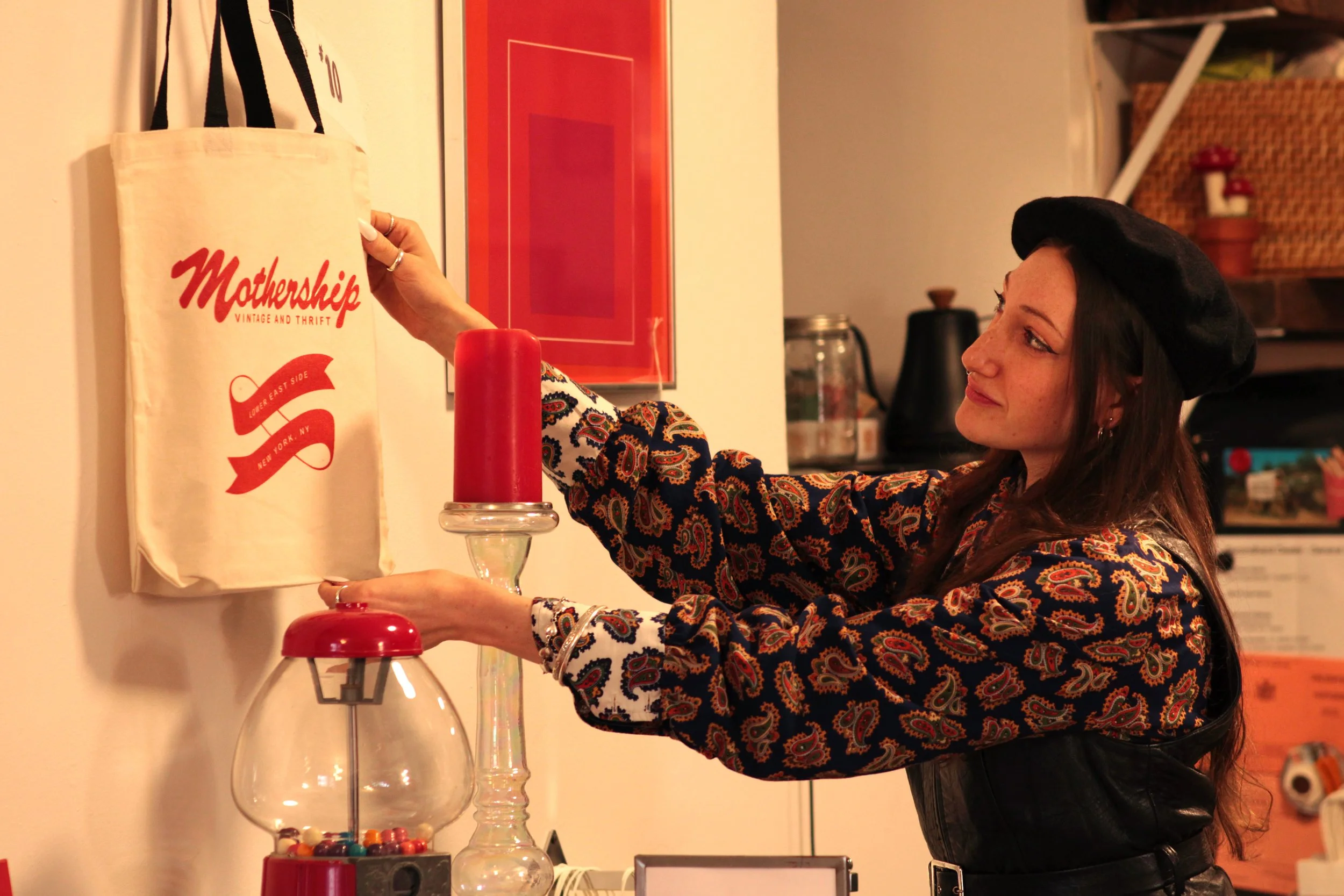
Mother of Kitsch: Mothership Thrift

by Eva Fournel, with images by Katey Cooney.
You can find Jane Shapiro on Instagram here, and Mothership linked here.
On a quiet stretch of Madison Avenue in the Lower East Side, is a quirky, whimsical, Alice-in-Wonderland-esque time capsule tucked away in a basement store-front where the queen of kitsch herself, Jane Shapiro, curates the absurd. Where strange things find a home and people rarely stay strangers for long.
I attended the opening for Mothership Thrift’s newest location in January of 2026. My first impression was that I’d stepped foot in my grandmother’s apartment with the familiar warmth of yellow light beaming off the collection of mid-century lamps and the stacks of old books, magazines, and records greeting me at the entrance. It felt like a family reunion with people from all ages in conversation stacked on top of each other on the sofas towards the back of the space. At first glance, it seemed like the owner, Shapiro, had simply invited her usual friend group to celebrate. But the longer I stayed, the more I realized that many of the people greeting her with hugs and inside jokes had met her the same way anyone might: by walking into the store as customers.
“I have made friends with a lot of my regulars,” Shapiro says. “You come in to shop, but then you also come in to hang out.”
In an area like the LES, full of vintage stores that focus on designer pieces and archival fashion, Mothership takes a different approach.
Instead of rare labels or luxury items, Shapiro gravitates toward the strange, nostalgic, and slightly absurd.
“Other vintage shops in this neighborhood are very designer focused,” she says. “I’m kind of on the other side of it. ”
The store is full of things that make you tilt your head for a second: kitschy Avon packaging, antique lighters, tiny framed artworks, cameras, cigarette cases, and other odd decorative gadgets and gizmos.
“I like things that you look at and go, ‘Why was this made?’” Shapiro says.
Rather than feeling like a carefully curated showroom, the store reads more like a time capsule of everyday life — objects that might have belonged to someone’s aunt in the 1970s or sat on a kitchen counter decades ago.
She describes the mentality as, “Let’s look at all the crap that’s in the world that we still love and is still really fun, but it’s not like prestige brands, just things that we think are joyful!”.
Much of the inventory is sourced by Shapiro and her mother, Bonnie, who now works with her full-time, scouring estate sales, auctions, and private collections to source for Mothership.
“She’s definitely mid-century kitsch, fifties and sixties,” Shapiro says. “I’m more seventies, and also nineties punk and grunge.”
Shapiro’s love for this kind of collecting and nostalgic world building started early.
She grew up in Binghamton, New York, which she describes as “a pretty economically depressed area,” saying, “there’s not a lot of art or culture, not much of a music scene.”
Though in a bubble of beige, her house was anything but ordinary.
“We lived in a mid-century ranch built in the 1960s,” she says. “And the whole place was like the 1950s. Everything was aqua and teal, very kitschy.”
Jane’s mom had been collecting vintage for years filling their home with inherited pieces, estate sale finds, and thrifted antiques.
“My grandma had like seventeen typewriters in her house,” Shapiro says.
The apple didn’t fall too far from the tree, and vintage shopping became a regular bonding activity for the Shapiro women. By middle school, Shapiro stopped buying new clothes altogether.
“I stopped buying new clothes just flat out for environmental reasons,” she says. “So we were going to thrift stores all the time.”
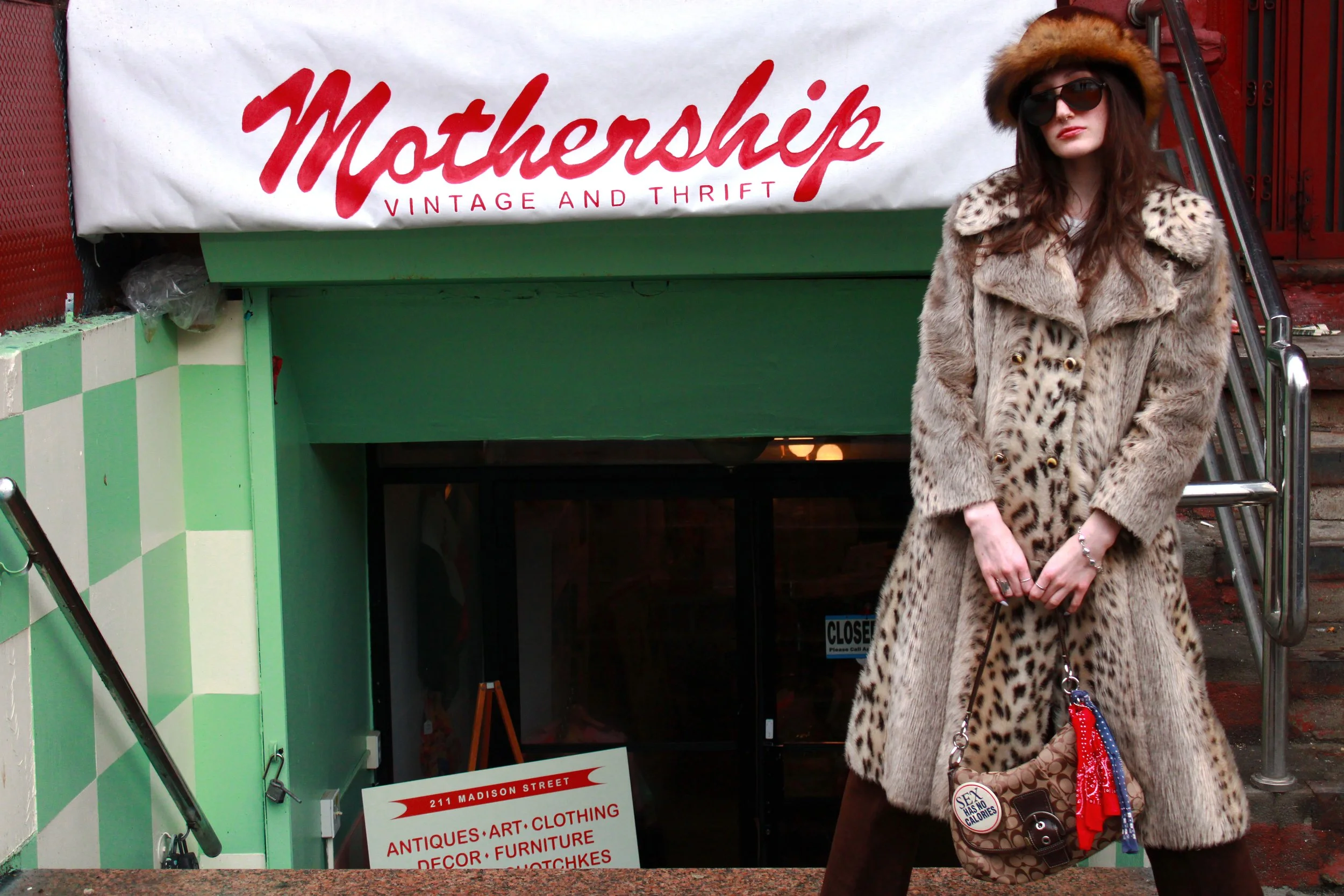
Shapiro in front of her store.
The Small Business Bug
Long before the inception of Mothership, Shapiro always knew she wanted to run a small business.
“The plan was always to have a small business,” she says.
As a kid, she even started a greeting card company, designing birthday cards and bookkeeping for fun.
“I loved it,” she says, laughing. “Doing bookkeeping as a kid—that was fun for me.”
The deeper motivation behind the business bug wasn’t solely a passion for entrepreneurship, but a desire to build community.
“I was always trying to find community space,” she explains. “That was a big thing that was lacking in my hometown.”
At one point, Shapiro even went as far as to try to purchase an abandoned factory in Binghamton to turn into a creative hub, or’third space’ she felt the community was lacking.
“I was going to the local city offices trying to figure out who owned it because I just wanted to find public space to use,” she says.
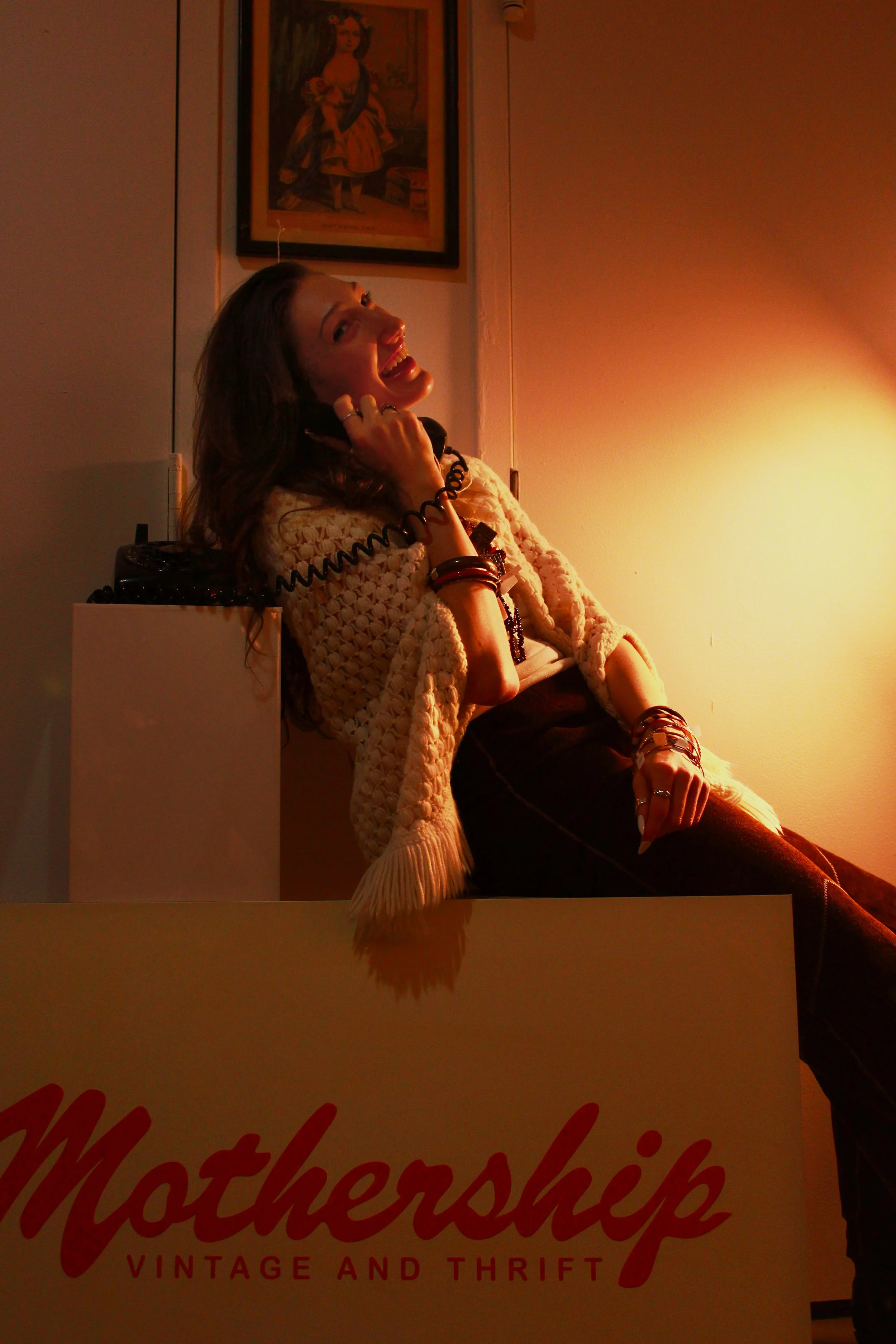
On Starting Mothership
“I worked in diapers for several years,” referring to her old brand marketing job at a diaper company.
The job paid well, but the corporate structure felt limiting for the kind of ambitions she had. Eventually, a coworker encouraged her to take the leap she had been considering long enough.
“If you want to start a company, now’s the time,” the coworker told her. “There’s never going to be a perfect moment.”
So she quit.
In March 2024, Mothership opened its first location just three doors down from its current storefront.
The block itself isn’t particularly glamorous. Madison Street sits slightly outside the main shopping routes of the Lower East Side, but Shapiro has grown attached to it.
“I think of it as like a fucked-up Sesame Street,” she says. “I know all my neighbors. We hang out, we do holidays together, and it’s a lot of unlikely friendships and from all different ages and backgrounds”.
The clientele reflects that perfect neighborhood mix: longtime residents who have lived in the area for decades alongside younger newcomers discovering the store through social media.
“I have tons of older people who come in,” she says. “And people who’ve been neighborhood dwellers for decades. Then I have a lot of new people too. I love that.”
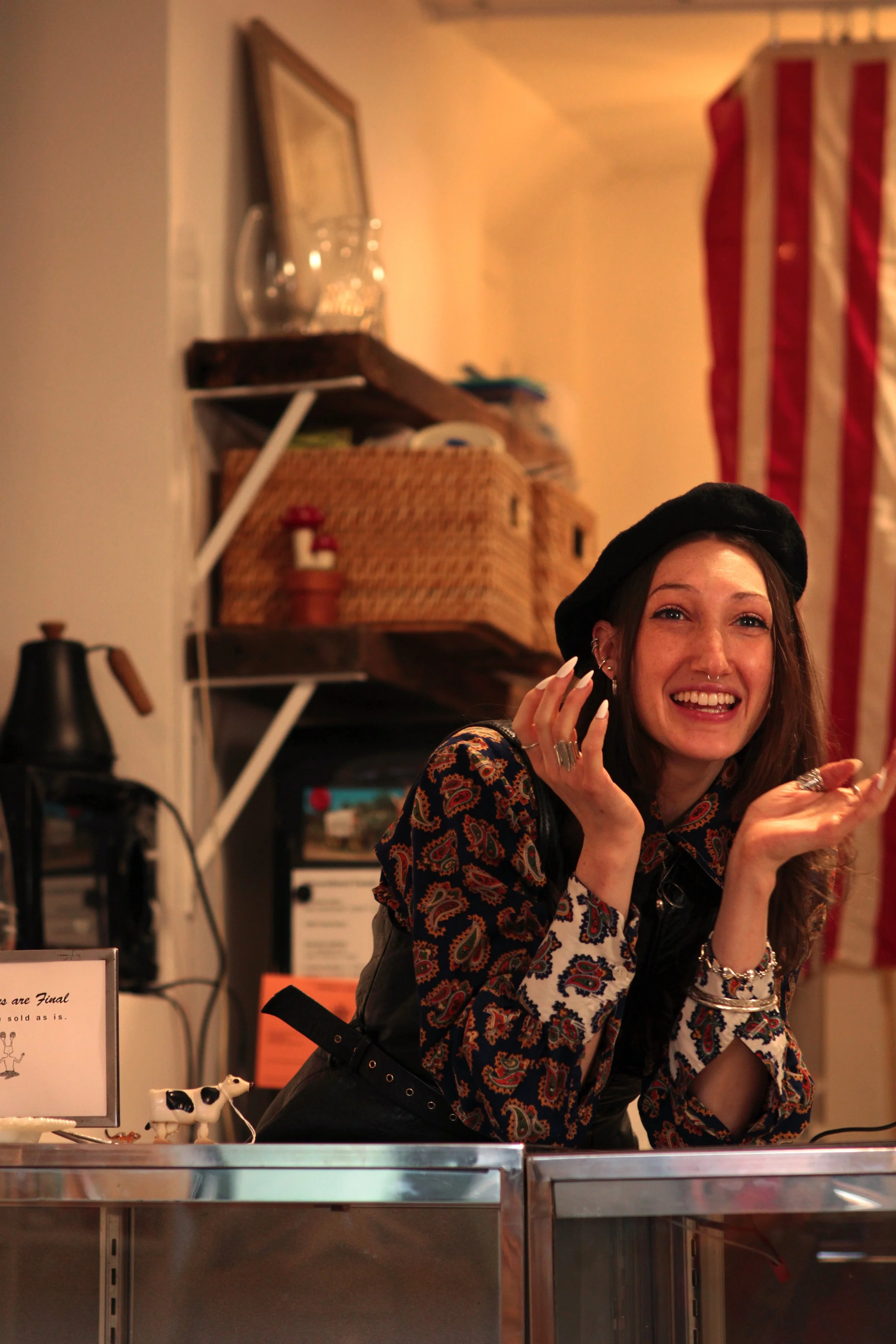
Shapiro, behind the counter.
The People Make the Place
The philosophy of Mothership is clear. The furniture is technically for sale, but it’s also meant to be used. Customers have the freedom to sit, linger, and talk.
Unlike many New York stores, no one is rushing anyone out the door.
“I’m always here,” Shapiro says. “Customer service is a top-tier need.”
She’s especially aware of how unwelcoming some vintage stores can feel.
Talking to vintage store owners can often feel like a pissing contest where I’m taking an archival Vogue Runway quiz IRL and failing miserably.
“Let’s be honest,” she says. “A lot of vintage shops—the staff isn’t nice. They’re cool, but they’re not welcoming.”
Mothership operates quite differently.
“We are not too cool for school.”
The result is that the shop has slowly evolved into a small social hub.
Many customers now stop by just to say hello. Some bring coffee. Others linger for long conversations.
“I have regulars, which I think is really cute,” Shapiro says. “And I’ve made friends with a lot of them.”
One of those friendships formed with Dylan Heller, who first stumbled into the shop as a customer.
Heller remembers the moment she first met Shapiro inside the store. “Jane and Xani (a friend of Shapiro’s whom she also met in the store months prior) were talking about some date drama,” she laughs. “I was in the dressing room trying something on, and when I came out we just all got into a conversation. Suddenly it was like—okay, we’re all friends now.”
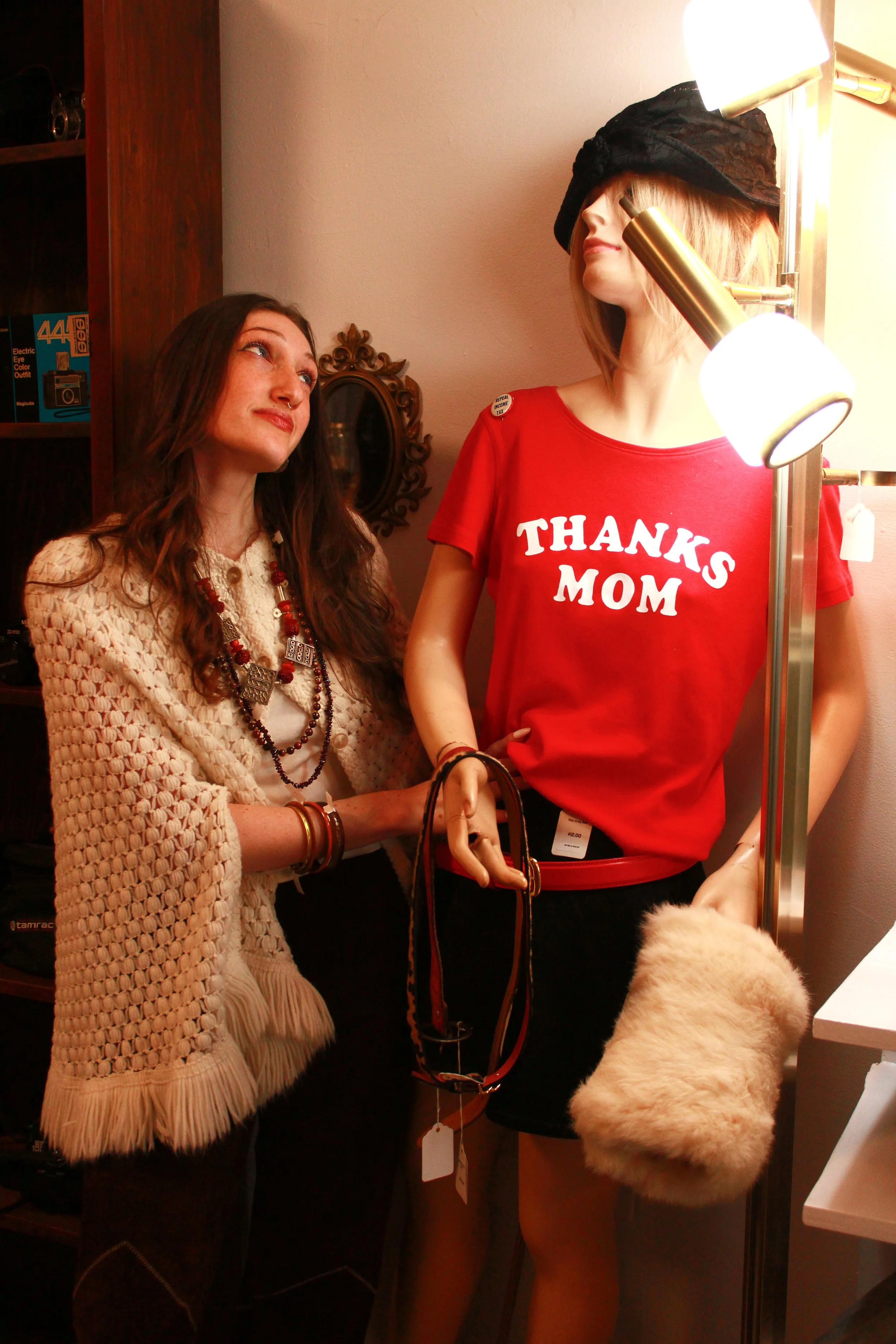
Shapiro besides her “Thanks, Mom” shirt
Where Will the Mothership Head Next?
Mothership is a visual representation of Shapiro herself: playful, nostalgic, and slightly irreverent. Nothing is too serious, and nothing is too strange to belong. A kitschy Avon bottle might sit beside a vintage camera or a stack of multicolored bangles—a real Mary Poppins treasure chest.
Looking ahead, Shapiro naturally aspires to always up the whimsy with new curious chotskies and vintage clothing waiting for their next life. Beyond that, she hopes Mothership will evolve even further into the community hub she’s always dreamed of.
She envisions film screenings in the backyard, small markets, event series, and creative collaborations with artists and vendors.
“I think of it as kind of like a big art project,” she says.
Running a small business in New York is not easy. The financial pressures are real, the risk is daunting, and the work is constant.
“You do get burnt out,” she admits. “You have to be in love with what you’re doing.”